



Case Study
PV Automotive uses intelligent Route Planning for on-time spare parts delivery
Uhlmann Pac-Systeme GmbH & Co. KG has standardised and optimised its global service processes. Digitising workflows with VISITOUR has minimised effort and throughput times, improved data quality, and helps the organisation manage growth with the same staffing levels.
The company: Customer service with the highest precision
PV Automotive GmbH is a leading provider of automotive services in Germany. With 1,600 employees, PV supplies car and commercial vehicle workshops, freight forwarders, municipal transport operators, independent parts dealers, and gas stations with a comprehensive range of goods, services, and products—from complete workshop systems and equipment to spare parts and accessories.
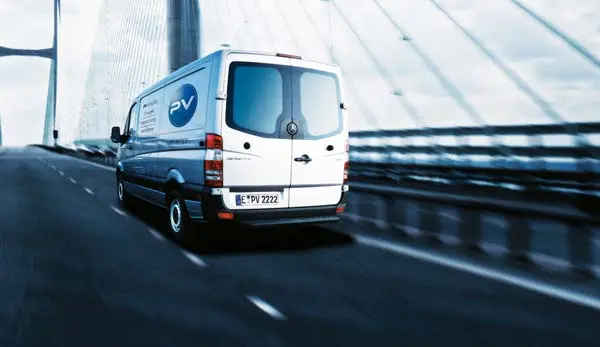
From more than 90 branches, PV can supply every location in its sales territory several times a day thanks to a fleet of Sprinter vans. In addition, each vehicle runs an average of four tours per day with up to 20 delivery stops. VISITOUR ensures maximum precision, efficient Route Planning, and impressively short times between order receipt and delivery.
Complex intraday capacity and route management
The VISITOUR server acts as a black box and is accessed directly by PV’s ERP system. All calls are transmitted to VISITOUR via SOAP/XML. Within seconds, the software calculates the most efficient tours for unbeatable delivery and service quality—taking into account numerous freely definable factors and providing precise information on distances and travel times.
Optimised dispatching
The dispatchers’ task is to allocate orders and appointments optimally across the available Operatives (drivers and vehicles)—both for the current day and for plans extending further into the week. The software processes orders and assignments in the most cost-efficient way while ensuring a high service level and an economical field service operation.
The software takes all framework conditions into account and assigns orders to suitable tours to increase satisfaction among customers and employees. It finds the right balance between costs and benefits for PV and maximises the impact of the service deployment.
Precise and dynamic route planning
Beyond pure working hours, the digitised planning also calculates the expected duration required to complete an order realistically. The underlying driving routes are planned precisely—based on road types, vehicle specifications, and varying driving speeds at different times of day. This is a crucial building block for both recurring and new intraday orders.
Dynamic route planning calculates multiple intermediate stops within a shift. This is typical for field service operations with time-bound deliveries. In such cases, planning is not centered on a single main destination, but includes multiple customers and/or depot visits.
This distinction is crucial when it comes to routes as opposed to Route Planning. Dynamic Route Planning groups orders into tours and determines the sequence in which they are visited. After the last order on a tour, the driver and/or vehicle returns to the starting point. A route, by contrast, usually refers to the trip from a starting point to a specific destination—i.e., transporting from point A to point B—without sufficiently considering the downstream effects. This risk is eliminated.
Simplification of internal release processes
Using the approval monitor primarily digitised the internal approval and follow-up processes for service orders, massively simplifying and accelerating them. Previously, all order documents and checklists had to be transferred manually in paper form or scanned and checked in order to initiate subsequent processes such as travel expense approval, payroll accounting, and customer invoicing.
Today, feedback is reviewed and follow-up processes are triggered across departments digitally and largely automatically using the approval monitor. This reduced internal logistics effort by 95% and enabled the increased order volume to be handled with the same staffing levels.
Digitising service orders alone made it possible to eliminate eleven folder carts at Uhlmann Pac-Systeme’s Laupheim site, which were filled with around 2,000 paper folders each year. Even during the rollout phase, this saved 35,000 printed pages per year, equivalent to half a ton of wood, over 9,000 liters of water, 1,800 kWh of energy, and 185 kilograms of CO2.
Case study outcomes: The difference to your Field Service
All trademarks mentioned or displayed on this website are the property of their respective trademark owners.

Industry
Automotive
Products in Use
Website
Results
- Improved delivery times and better customer service
- Significant savings in fuel consumption and CO₂ costs
- Significantly reduced dispatching effort in customer service
- Seamless integration into the existing ERP (VISITOUR as a black box)
Start Your Project
Would you like to achieve such results? Let’s talk.
We’ll show you how to optimise your service.