



Blog
Field Service Resource Planning to Improve Efficiency and Increase Job Completion
A shortage of skilled staff, increasing profitability demands, and intensive operations: Intelligent resource planning in real time means identifying potential bottlenecks at an early stage, ensuring service quality, and designing schedules for additional job capacity.

Contents
Resource Planning in Field Service: Key Points
- Resource planning ensures that technicians, skills, vehicles and materials are available at the right time.
- The real bottleneck in field service is usually capacity, not demand.
- Without an overview of capacity, bottlenecks relating to skills or regions remain hidden for a long time.
- Effective resource planning stabilises service quality and reduces unnecessary costs.
- Tools such as VISITOUR from Solvares Field Service often unlock 20 per cent or more in additional capacity through optimised deployment and dynamic route planning.
What does resource planning mean in field service?
Resource planning in field service refers to the structured planning and management of all resources required for service call-outs. These primarily include service technicians, their working hours, skills/qualifications, vehicles, tools, spare parts and available information.
Ensure the right resources (operatives with the appropriate skills, vehicles, materials and information) are available in sufficient quantities at the right time to meet expected demand efficiently.
In technical services, this task is particularly challenging. This is because many ‘moving’ parts come into play here:
- Customer enquiries and faults
- Maintenance and inspection appointments
- Technicians with different skills
- Limited capacity
- Travel times and regional differences
- Spare parts and tools
- SLAs and contractual requirements
- Last-minute changes during the day
- Seasonal fluctuations
- Emergencies and unplanned reactive call-outs
Resource planning is therefore an attempt to manage this complexity in a long-term and strategic manner.
Resource planning, operational planning, and scheduling: what is the difference?
These terms are often used interchangeably in everyday field service. However, it is worth distinguishing between them to ensure effective management.
Resource planning takes a fundamental and long-term view of available resources: What capacity do we have? What skills are available? Where might bottlenecks arise? How do we deploy staff, time, vehicles and materials as effectively as possible?
Deployment planning translates these resources into specific assignments: Which task is to be carried out by whom and when? Here, the planning horizon is usually between one day and a few weeks.
Dispatching is the (rather reactive) in-day management of operations, involving fine-tuning and readjustments: Scheduling, rescheduling and prioritising escalations, clarifying queries, processing changes and informing customers.
Why resource planning is important in technical services
In many service organisations, the bottleneck is neither the market nor financial resources. The bottleneck is the available resources.
There are enough orders, enough customer demand and enough service potential. But the question is: Does the team have enough capacity to meet this demand effectively? And if not: How can we get more out of the existing resources without permanently overburdening technicians and dispatchers?
Good resource planning, just like good deployment planning and scheduling, makes key objectives achievable:
1. Complete more jobs using the same resources
Better planning and real-time management reduce downtime, unnecessary journeys and manual coordination. This enables the team to complete more jobs without the immediate need to recruit new staff.
2. Identify planning bottlenecks at an early stage
Typical questions include:
- Do we have enough capacity for the coming weeks?
- Which skills are we most frequently lacking?
- Where do bottlenecks regularly occur?
- Which teams are under- or over-utilised?
- Which types of orders take up a particularly large amount of time?
- Where do travel times hinder productive capacity?
Without clear data, such bottlenecks often remain a matter of gut feeling. With systematic resource planning, they become manageable.
3. Maintain a consistent standard of service quality
Good resource planning safeguards service quality. It helps to make realistic commitments, meet SLAs and serve customers reliably.
This is particularly important in sectors with critical equipment, tight maintenance windows or contractual obligations.
4. Reducing costs without compromising on service
- Less travel time
- Less idle time
- Less overtime
- Fewer queries
- Less duplication of work
- Fewer unplanned return journeys
- Less manual planning by office staff
This is not about ‘cutting corners’ on service. This is: Good resource planning and scheduling to ensure available resources are deployed where they deliver the greatest benefit.
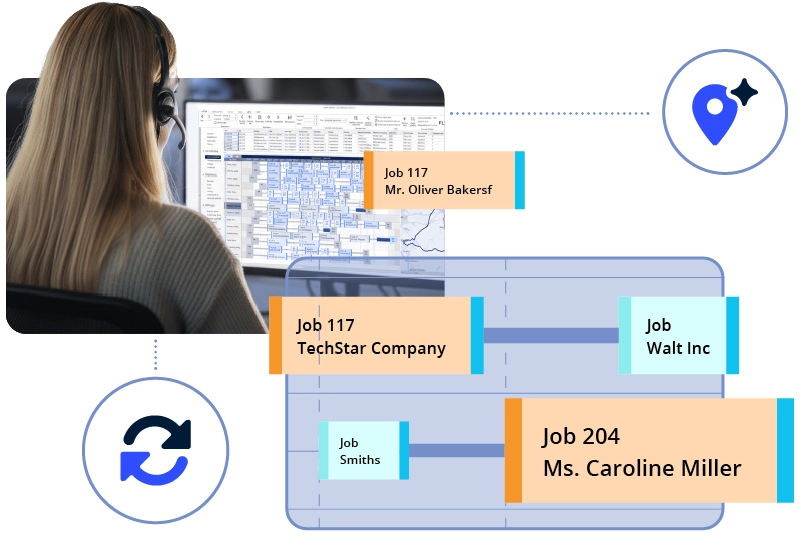
Planning is the key function when it comes to ensuring that available resources are deployed effectively in day-to-day operations.
What resources need to be planned for field service?
Resource planning is often reduced to staff planning. This is too narrow a view. In field service, several resources must work together.
Staff and skills
A job is only properly planned when the right person with the right skills is available.
Time and capacity
Planning therefore needs to take into account working hours, breaks, on-call duty, holiday, sick leave, duration of assignments, travel time and time slots. If these factors are not planned carefully, it is easy to overestimate the team’s actual capacity.
Vehicles, tools and equipment
If these resources are not available, even the best technician is of no help. Good planning therefore takes into account not only the people involved, but also the resources they need to carry out the job.
Spare parts and materials
This applies in particular to technical services involving complex systems, maintenance, repairs or installations.
Information
If this information is missing, productivity falls. This leads to queries, delays and unnecessary errors.
Warning signs: When your resource planning is no longer working
- You are not certain whether your capacity will be sufficient for the coming weeks.
- Shortages of specific skills or in certain regions only become apparent once they are already acute.
- Decisions regarding new staff, shifts or vehicles tend to be based on the experience of individual staff members rather than on reliable data.
- Certain skills or teams are regularly overbooked, whilst others are consistently underutilised, without this being systematically noticed.
- New orders, regions or service contracts are accepted without it being clear whether the available capacity is actually sufficient.
- Growth makes planning disproportionately more complex, rather than allowing for predictable scaling.
- There is no reliable, up-to-date overview of the qualifications available within the team and where gaps exist.
- Workload, capacity and bottlenecks cannot be displayed at the touch of a button, but must be painstakingly collated.
These are not purely organisational problems. They are management issues.
The challenges of resource planning in the service sector
What makes resource planning in field service so difficult is that nobody can predict the future. Furthermore, there are factors that have a long-term impact and can only be influenced to a limited extent.
Demand is difficult to predict
That is why resource planning in field service must achieve two things: a reliable forecast of expected demand and the ability to continuously review and adjust capacity assumptions.
How to respond at short notice to individual deviations in day-to-day operations, on the other hand, is the task of downstream deployment planning and scheduling.
Resources are scarce
The shortage of skilled workers is hitting many service organisations hard. Technicians with the right qualifications are hard to find. At the same time, demand for services is rising.
The challenge is therefore often not: ‘How do we get more resources?’, but rather: ‘How do we achieve more with the resources we have, and how do we use them more effectively?’
Complexity increases with every job
A small team with just a few skill profiles can still be managed using a simple spreadsheet. However, with a growing field service team involving many different qualifications, regions and contract types, this is no longer sufficient to make reliable assessments of capacity.
Unsuitable tools slow down the service
These tools display data. However, they rarely provide reliable capacity forecasts, do not automatically identify skills shortages and offer little support for ‘what-if’ scenarios, such as for a new major contract, an additional region or a changed contract model.
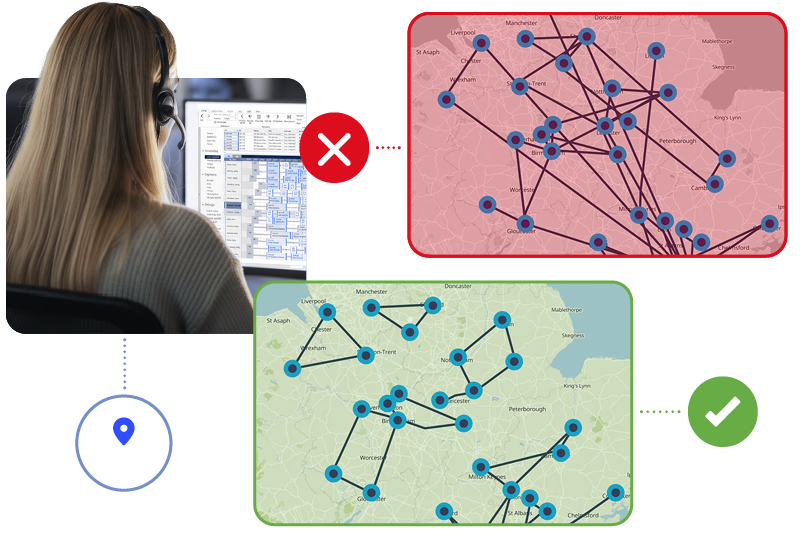
Efficient use of resources or daily chaos? As well as strategic resource planning, operational management is also key.
How modern resource planning works in field service
1. Ensure resources are transparent
These include:
- Available technicians
- Working hours and absences
- Qualifications and certificates
- Regional responsibilities
- Vehicles and equipment
- Available time slots
- Current workload
- Scheduled maintenance
- Outstanding faults
- Material and spare parts status
Without this transparency, resource planning remains a matter of guesswork. With it, it becomes manageable.
2. Matching demand and capacity
This enables service managers to identify at an early stage whether existing resources are sufficient or whether bottlenecks are likely to arise. This overview is particularly important for maintenance planning, seasonal peaks, roll-outs, installation projects or service contracts with tight response times.
3. Providing automated support for capacity decisions
Modern software can automatically run through various scenarios here: Is there sufficient capacity for a new major order? What skills gap will arise if a specialist is absent? Where would it be worthwhile to redistribute responsibilities?
The actual translation of these capacities into individual assignments and routes is then handled by resource planning. However, the foundation for this is provided by effective resource planning.
4. Keep capacity assumptions up to date
Good resource planning therefore regularly checks whether the original assumptions still hold true and adjusts capacity planning accordingly.
By contrast, the short-term, day-to-day response to individual absences or emergencies is the responsibility of scheduling. However, scheduling benefits from the underlying resource planning being realistic and up to date.
5. Integrating mobile processes
Digital service reports, status updates and feedback from field operations provide precisely this data. This means that capacity estimates are not simply set once, but are continuously reconciled with reality.

The field service app connects the field staff to the dispatch team.
6. Continuously improve resource planning
Key performance indicators include, for example:
- Overall utilisation by team, region or skills group
- Coverage rate of individual qualifications compared to demand
- Accuracy of capacity forecasting (planned vs. actual demand)
- Proportion of unmet demand per period
- Lead time for capacity decisions, for example when scaling up staff
- Staff turnover and the time taken to train new skills
- Over- and under-utilisation of individual skill groups over time
This data shows where resources are being used effectively and where potential is being wasted.
Field Service Resource Planning Software: What Matters Most
A suitable solution covers the resource planning itself and, at the same time, integrates seamlessly with the downstream levels:
At the resource planning level:
- Capacity overview
- Skills and qualifications management
- Capacity forecasts and what-if scenarios
- Reporting and KPI analysis
Adjacent to this, for an end-to-end process:
- Resource planning
- Route optimisation
- Priority and SLA management
- Real-time re-optimisation
- Mobile order processing
- Digital service reports
- ERP and CRM integration
Why resource planning must take account of operational planning and route optimisation
Even when sufficient resources are available, jobs can still sometimes be left undone – for example, because routes are poorly planned, jobs are not bundled, teams are unevenly utilised, or information is missing.
That is why it is worth considering resource planning, deployment planning and route optimisation together. Experience from our client projects shows that field service teams often gain 20 per cent or more in capacity simply through improved deployment and route planning (you can find our case studies here).
Resource planning with Solvares
Solvares Field Service offers VISITOUR, a solution for smart field service management. The software automatically plans assignments and routes, taking into account skills, time slots and SLAs, and adjusts plans in real time if anything changes during the day. This enables dispatchers to maintain a clear overview at all times and manage the field service team with a high degree of responsiveness.
In addition to operational management, Solvares solutions also allow for the strategic optimisation of resource planning. For example, portatour® offers a territory optimisation tool that can be used not only in sales but also in many service organisations.
Conclusion: Effective resource planning makes field service manageable
Those who take resource planning seriously look not just at individual assignments, but at the interplay between staff, skills, time, vehicles, materials, information and demand. This is precisely where the leverage lies. Because often, it is not just staff that are lacking. What is lacking is the ability to manage the situation.
With clear processes, good data and the right Field Service Management Software, this complexity can be managed. Service organisations gain transparency, reduce inefficiencies and achieve greater performance with the same resources.
Author:

André Bock
Sales Manager & Senior Consultant
Background and expertise in the field of FSM:
- Graduate in Economics and Mathematics (Schleswig-Holstein University of Applied Sciences)
- Has been working in the FSM sector since 2008, in a wide variety of roles
- Support and project management for over 100 client projects
André Bock is an expert in Field Service Management (FSM), specialising in resource planning, route optimisation and digital service processes. As an employee of Solvares Field Service (formerly FLS – FAST LEAN SMART), he has spent over 17 years exploring how companies can manage their technical field service teams more efficiently, productively and in a more customer-focused manner.